
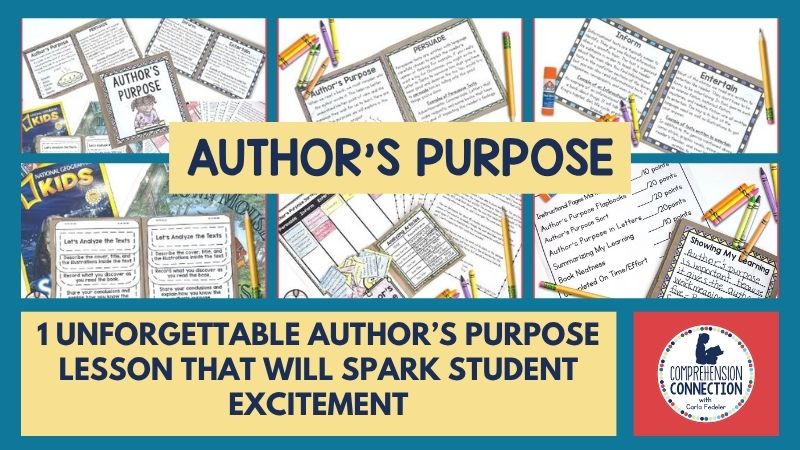
Looking for an author’s purpose lesson that your students will truly enjoy? In this post, I’m going to share one of my favorite ways to teach the five author’s purposes (Persuade, Inform, Entertain, Explain, and Describe). Kids love hands-on projects, and this project includes all you need for modeling, guided practice, and assessment.
Author’s purpose is often a tricky skill for kids to learn. They generally master a few purposes right away including persuade and entertain, but I find they often confuse inform, explain, and describe. I hope with the tips below, your author’s purpose lesson will provide the clarity your kids to master all five. Now…let’s get into the details.
What to Include in Your Author’s Purpose Lesson:
Attention Grabber to Introduce Your Author’s Purpose Lesson:
When teaching author’s purpose, the first thing I do is connect to real life examples. Sharing familiar texts and having students group them could lead to author’s purpose connections. You might have your students work in teams to sort text examples. You may not even give them the five author’s purposes to begin with just to see if they make the connections on their own.
Explain the Five Author’s Purposes
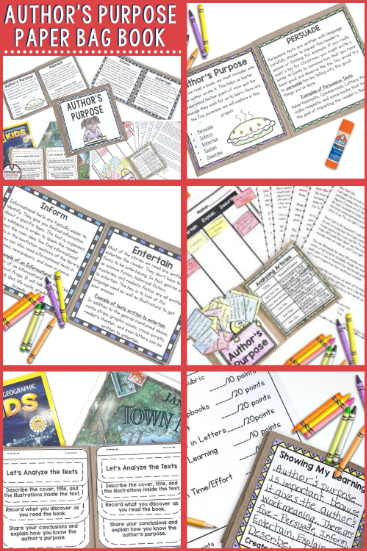
The second step of your author’s purpose lesson should be to explain each purpose and how they differ with the others. Kids need to be able to recognize the language used not only for reading, but also for writing. As writers, they organize their writing based on the purpose and use specific words for that purpose too. You can use the the first part of my paper bag book for reference as you teach them, and your students can refer to these notes later too.
Analyze Text Examples to Determine the Author’s Purpose
The next part of the paper bag book refers to text examples. You will need to pull back out the books you started with and choose one for each purpose. Mark text examples with sticky notes to share with students to model why a book fits the author’s purpose or have your students work in teams to do this with more of an inquiry type approach. Discuss.
Use the Author’s Purpose Sorting Mats to Continue Practicing and for a Formative Assessment
The last part of the lesson includes a sorting mat and various text example cards. Students work to determine the author’s purpose of based on the text description. This can be done as a group or individually.
Other Activities for Your Author’s Purpose Lesson:
Of course, you will need additional ways to solidify your students understanding of author’s purpose. Here is a list of follow up activities you might try:
- Analyzing Text for Clues: Model and practice analyzing short passages or chapters, using sticky notes to mark text evidence (words, phrases, sentences) that supports the determined author’s purpose.
- Writing for a Purpose (Doughnut Challenge): Challenge students to write a story or passage on the same topic (like a doughnut) but for a different purpose (e.g., persuade someone to buy it, inform on its ingredients, describe its taste, entertain with a story about it).
- Skits and Role-Playing: Give small groups a topic and a purpose (e.g., “persuade your class to get a class pet”) and have them create and perform a short skit. The rest of the class identifies the purpose.
- Book Order Sort (for primary grades): Use old scholastic book order catalogs. Have students cut out book covers and paste them onto a three-sectioned paper labeled “Persuade,” “Inform,” and “Entertain.”
- Library Scavenger Hunt: Have students visit the library or use the classroom library. Using only the book’s cover, blurb, and table of contents, they try to find X number of examples for each purpose.
Get Your Copy of these Easy to Use Organizers:
To help you get started, I’d like to share these printables with you. You can use them for note-taking, as recording forms as students work on some of the activities above, and for your interactive notebooks.
Looking at Author’s Purpose from the Writer’s Point of View
Author’s purpose is important because it helps the writer know why they are writing and what they want their readers to understand or feel. When writers have a clear purpose, they can choose the right words, details, and tone to make their message clear. It keeps their writing focused and helps them connect better with their audience. Without a purpose, writing can feel scattered, but with a clear purpose, the writer’s message becomes stronger and easier to follow.
Interested in purchasing this resource?
I think you and your students would enjoy using this for your author’s purpose lesson. You do not have to make it into a book if you do not want to. You can use the pages in an interactive notebook instead.







One Response
I am thankful for participating in this blog hop and my village that helps me with my son day in and day out.